Tank vs Tankless Water Heater: Which Is Right for Your Aurora Home?
Comparing tank and tankless water heaters for Aurora homeowners. Costs, lifespan, efficiency, and hard water considerations explained.

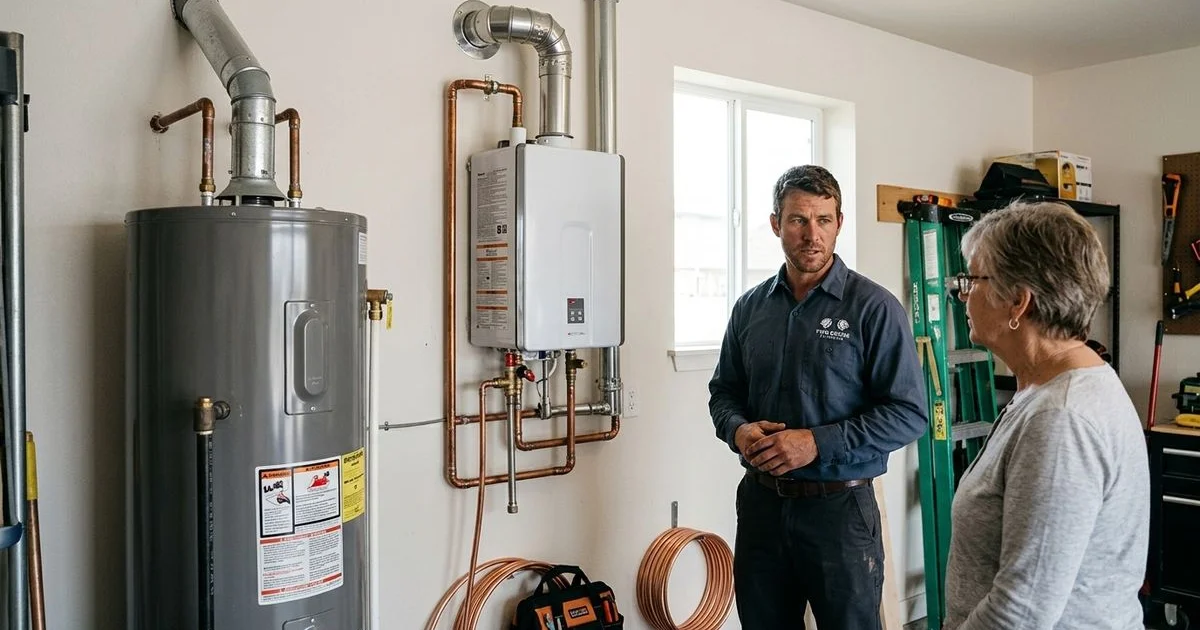
You know how frustrating it is when a major home appliance fails and you suddenly have to become an expert overnight. The big question is always Tank vs Tankless Water Heater: Which Is Right for Your Aurora Home? Two Bears Plumbing started with a simple goal: be the plumber Aurora homeowners can trust when things go wrong. We know your time matters and your budget is tight.
The water heater debate is one of those classic homeowner headaches. This is especially true here in Colorado, where local conditions completely change the math. Choosing between a standard tank and a tankless upgrade requires matching the technology to our specific climate challenges.
The real deciding factor is how these systems hold up against extreme mineral content and high elevation.
Let’s look at the data, what it actually means for your daily usage, and explore a few practical ways to respond. We are going to break down how each system operates, compare the 2026 costs, and outline exactly which unit fits your household best. Finding the perfect balance starts with understanding the equipment.
How Each System Works
Both options operate on completely different principles. Understanding these mechanics helps clarify why they perform differently at elevation. We want you to grasp the basics before looking at the price tags. Let’s examine the traditional storage method first.
Tank Water Heaters
A traditional tank water heater stores 40 to 80 gallons of water in an insulated basin. Gas models heat the supply using a burner located at the bottom. Our team frequently installs reliable, high-capacity brands like Bradford White for these standard setups.
These traditional units typically offer a Uniform Energy Factor (UEF) rating between 0.60 and 0.70. One common pitfall is thermal stacking, a situation where water at the top becomes scalding hot while the bottom remains uncomfortably cool.
Tankless Water Heaters
A tankless unit, often called an on-demand heater, operates without a storage basin. Cold water flows directly through the device and is heated instantly by a high-powered gas burner or electric element. We highly recommend top-tier brands like Navien or Rinnai for their superior, consistent performance.
These modern units boast UEF ratings between 0.82 and 0.95, making them incredibly efficient. Keep in mind the ‘cold water sandwich’ effect, which is a brief burst of cold water occurring when you turn the tap off and back on quickly.
Tank vs Tankless Water Heater: Which Is Right for Your Aurora Home? A Side-by-Side Comparison
Seeing the specifications clearly laid out makes the comparison much easier. This quick reference guide highlights the major operational differences. We use this exact data to help clients weigh their options during consultations. Review the metrics below to see how each technology stacks up.
| Factor | Tank | Tankless |
|---|---|---|
| Upfront cost (installed) | $1,600 to $2,500 | $3,500 to $6,500 |
| Uniform Energy Factor (UEF) | 0.60 to 0.70 | 0.82 to 0.95 |
| Lifespan (Aurora hard water) | 6 to 8 years | 15 to 20 years |
| Recovery time | 30 to 60 minutes | Instant |
| Altitude adjustment | None needed | Must be derated for 5,400 feet |
Upfront Cost
Tank water heaters cost significantly less to purchase and install initially. A quality 50-gallon gas tank unit installed typically runs $1,600 to $2,500. We include the unit, labor, local permits, and disposal of the old heater in that price. The building permit fee from the City of Aurora currently sits around $81.25 for a standard residential replacement.
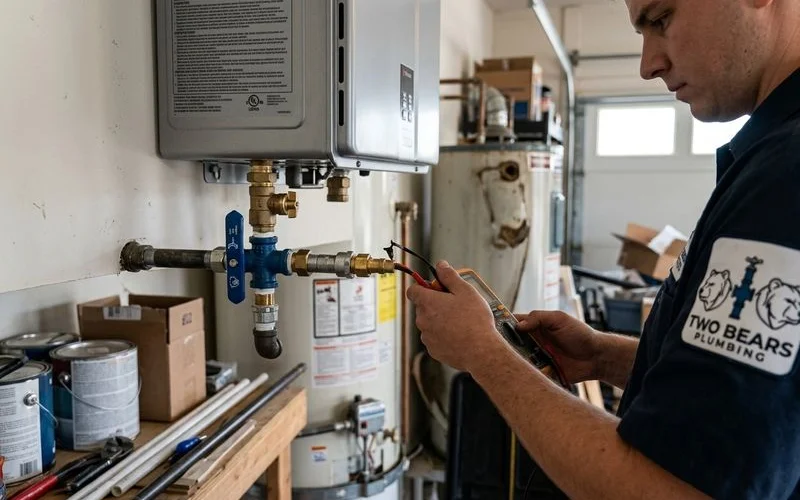
Converting an existing tank setup to tankless requires extensive infrastructure changes. Our technicians often have to upgrade gas lines, install new venting runs, and make electrical modifications. This pushes the initial tankless installation cost to between $3,500 and $6,500. Paying for these required upgrades is the primary reason the on-demand option carries a heavier initial price tag.
Long-Term Cost
This category is where the on-demand technology starts to close the financial gap. Tankless water heaters are 24% to 34% more energy efficient than tank models for homes that use 41 gallons or less per day. We love seeing the relief on our customers’ faces when their utility statements drop.
Xcel Energy proposed an 11.4% natural gas rate increase starting in October 2026. That impending hike means those efficiency gains will soon translate to even larger dollar savings. The elimination of standby heat loss is the primary driver for these lower monthly bills.
Let’s look at a realistic 15-year financial breakdown for a local home:
- Traditional Tank: $1,800 purchase, plus $6,500 energy, plus $1,800 replacement equals roughly $10,100.
- Tankless System: $4,500 purchase, plus $3,800 energy, with zero replacement costs equals roughly $8,300.
You save approximately $1,800 over 15 years with the high-efficiency route. We always remind clients that actual savings depend heavily on daily usage patterns and consistent maintenance. Skipping annual service can quickly erase these financial benefits.
The Hard Water Factor
The hard water in Aurora is the single biggest variable in this comparison, and it affects both plumbing systems significantly. Recent 2026 water quality reports show the local supply measures an extreme 11.2 to 12.8 grains per gallon (GPG). We constantly repair premature equipment failures caused by these exact dissolved minerals.
This 12.8 GPG measurement is classified as ‘Very Hard’ and ranks among the most problematic in Colorado. Without intervention, this extreme mineral content reduces water heater efficiency by up to 29%.
Impact on Tank Models
Traditional units accumulate sediment directly at the bottom of the storage basin. This buildup happens much faster here than the national average. We replace dozens of neglected tanks every month that burst from internal corrosion.
Without annual flushing, the sediment reduces effective capacity and destroys the heating element. A standard tank that might last 12 years in a city with soft water often fails after just 6 to 8 years locally.
Impact on Tankless Models
These modern units face a different set of challenges. Hard water causes rapid mineral scale buildup on the heat exchanger. We perform annual descaling with a specialized vinegar flush to keep these units operational.
Scale reduces heating efficiency and can eventually crack the heat exchanger entirely. Skipping that yearly flush often leads to a massive $500 to $1,000 repair bill. Both systems benefit immensely from a companion whole-home water softener, which dramatically extends equipment life.
Altitude Matters in Aurora
The city of Aurora sits at approximately 5,400 feet in elevation. Gas appliances must be derated for altitude because there is less oxygen available for proper combustion. We always calculate this exact reduction before recommending a specific unit size.
Most manufacturers specify a 4% reduction in BTU output for every 1,000 feet above sea level. In practical terms, a gas tankless unit rated for 199,000 BTUs at sea level delivers roughly 156,000 BTUs here.
Pro-Tip: Because of the altitude derating, a unit that provides 9 Gallons Per Minute (GPM) at sea level may only deliver 7 GPM locally. Always size up your tankless system to ensure you have enough flow for multiple fixtures.
For most households, 7 GPM is still plenty for running a shower and a dishwasher simultaneously. Larger homes with multiple bathrooms in use at once might need a higher-capacity unit or a two-unit configuration. We routinely install tandem systems for properties with high simultaneous hot water demands. Proper sizing prevents that frustrating drop in pressure when someone flushes a toilet.
Who Should Choose a Tank Water Heater?
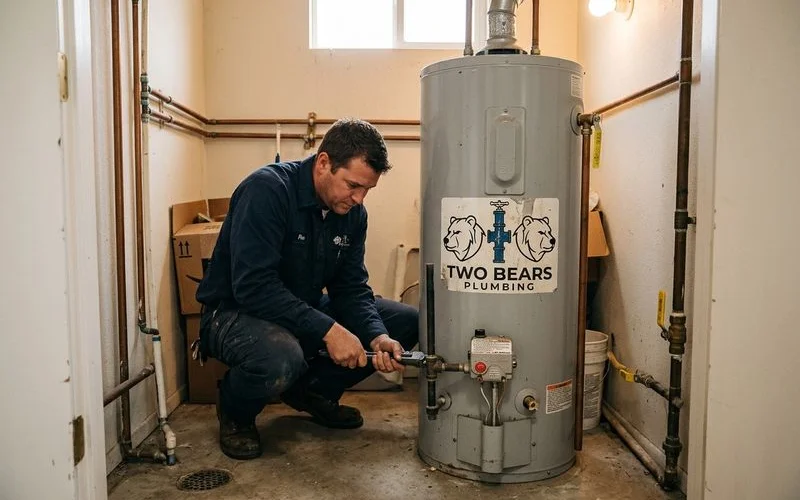
A traditional storage model makes perfect sense under certain specific conditions. Choosing this route offers reliability without the massive upfront investment. We usually recommend sticking with a standard unit if you meet the following criteria. Review your current situation before committing to a costly conversion.
- Your budget is tight and you need to keep upfront costs low.
- Your home’s gas line or electrical service cannot easily support a high-capacity upgrade.
- You have a relatively small household (1 to 3 people) with moderate daily demand.
- You plan on selling the property soon and want to maximize return on a smaller investment.
- Your current setup is a straightforward replacement with no expensive structural conversions needed.
Who Should Choose a Tankless Water Heater?
On-demand systems are brilliant investments for the right type of household. Upgrading provides endless hot water and reclaims valuable garage space. Our installation crews see incredible satisfaction rates from families who upgrade for the correct reasons. Consider making the leap if these points describe your living situation.
- You have a larger household (3+ people) that frequently runs out of hot water during peak morning hours.
- You plan to stay in the home long enough to recoup the higher upfront cost through energy savings.
- You want to reduce your monthly utility bills to offset upcoming Xcel Energy rate increases.
- You need to reclaim valuable floor space, since these compact units mount neatly on a wall.
- You already own a water softener or plan to install one concurrently to protect the heat exchanger.
Our Honest Recommendation
There is no universally right answer to the debate of Tank vs Tankless Water Heater: Which Is Right for Your Aurora Home? Both heating technologies are exceptionally reliable when properly sized, installed, and maintained.
We firmly believe that accounting for local mineral levels and elevation dictates performance more than any brand name ever will. The worst mistake you can make is ignoring those two environmental factors. Ensuring proper installation is equally vital for longevity.
Our water heater services include a full assessment of your home’s daily demand, gas capacity, and water quality before finalizing a recommendation. Making an informed choice saves you thousands of dollars over the lifespan of the equipment. Call us at (720) 903-1527 to schedule a comprehensive consultation.
We provide flat-rate pricing on all installations with zero hidden fees. Your family deserves an honest evaluation, no pressure tactics, and a solution that truly fits your budget.
Need Plumbing Help in Aurora?
Two Bears is your local Aurora plumber. Call now for same-day service. Upfront pricing, no hidden fees.
Call (720) 903-1527Related Service: Water heater repair in Aurora →